How to Price Handmade Items (Without Working for Free)
The first thing I ever sold was a zip pouch. Someone at a craft fair picked it up, turned it over, asked how much, and I heard myself say “oh, four pounds?” like it was a question. She paid, looked delighted, and walked off with something that had taken me the best part of an hour to make and about three pounds of fabric and zip to build. I had just paid myself roughly nothing to work for free in front of a stranger.
If you have ever done a version of that, this post is for you. I am an engineer by training, so I eventually did the thing I should have done at the start, which is sit down and actually work out the numbers. It turns out pricing handmade items is not a vibe or a guess. It is a formula, and once you have it, the awkward maths at the stall disappears.
Take the calculator with you
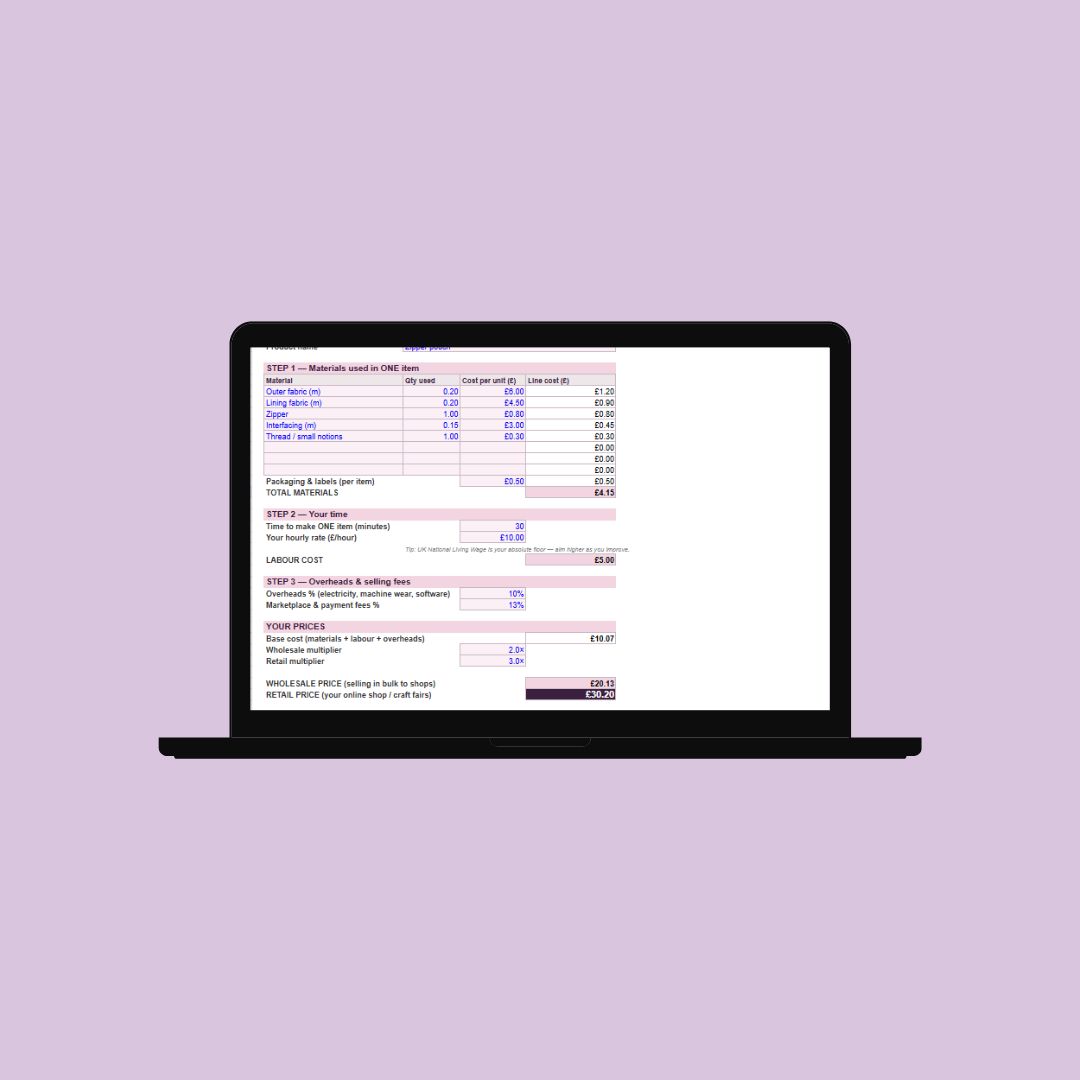
The simple spreadsheet version of what we just walked through, yours free.
Enter your materials and your time, and your cost price, wholesale price and retail price appear automatically. No formulas to learn, no spreadsheet experience needed.
One email with your download, then occasional sewing tips and freebies. Unsubscribe anytime.
Why handmade pricing goes wrong
Most makers underprice for one of a few reasons. You compare yourself to fast fashion, where a top costs less than your zip did. You forget that “materials” is not just the obvious fabric but the thread, interfacing, the zip, the offcuts you will never use, and the portion of the pattern you bought. And almost everyone forgets to pay themselves for their time, or pays themselves something like £2 an hour because charging real money feels cheeky.
The result is a hobby that quietly costs you money while looking like a business. That is a lovely hobby, and there is nothing wrong with making for the joy of it. But if you want your making to at least wash its own face, the price has to cover more than it usually does.
The formula for pricing handmade items
Here is the version I use. It is deliberately simple, because a formula you will actually use beats a perfect one you abandon.
Price = (Materials + Labour) + Overheads + Profit margin, then check against your fees.
Let me break down each piece.
Materials is everything the item physically consumes. Fabric, thread, zips, buttons, elastic, interfacing, and a sensible share of anything you buy in bulk. If a reel of thread does ten projects, that is a tenth of the reel per item. Weigh or estimate honestly. This is the engineer in me talking, but guessing “about a fiver” is how you lose money on the makes that quietly use more than you think.
Labour is your time multiplied by an hourly rate you are not ashamed of. Decide your rate first, separately, when you are not staring at a specific make and feeling shy about it. Even a modest £10 to £15 an hour changes the picture completely once you time yourself honestly, cutting and pressing included.
Overheads are the costs that are not tied to one item but still real. Your sewing machine servicing, needles, the electricity, a share of your selling platform fees, packaging. Many makers add a small percentage on top, say 10 to 15 percent, to cover this rather than tracking every needle.
Profit margin is the part that makes it a business rather than a break-even exercise. This is the money that lets you buy more fabric, or reinvest, or simply earn something. A common approach is to add a percentage on top of your combined costs.
Then the reality check. Once you have a price, look at what your selling platform takes. A marketplace, a market stall, and your own site all have different fees, and a price that looked healthy can get thin once fees and postage come out. Work backwards from the price the customer pays to what actually lands in your account.
A worked example
Say you make a lined tote. The fabric, lining, and handles cost you £6. It takes you 90 minutes, and your rate is £12 an hour, so labour is £18. Materials plus labour is £24. Add 15 percent overheads (£3.60) and you are at £27.60. Add a profit margin of 20 percent and you land near £33. Then you check your marketplace fees and your postage, and you adjust so the number that reaches you still respects that £33.
Suddenly the £15 you might have nervously charged looks like what it is, which is you paying the customer for the privilege of doing their sewing.
Use the free calculator (I built it so you never have to do this by hand)
Doing that maths by hand every time is tedious, and tedious things do not get done. So I built a free Handmade Pricing Calculator that does all of it for you. You pop in your materials, your time, your hourly rate, and your fees, and it gives you a fair price with the working shown. No spreadsheet, no formulas to remember.
It is free to use, it lives on the site, and it was built by someone who actually sews and sells, so the numbers behave the way a real maker needs them to.
A few honest notes on pricing
Charging properly feels uncomfortable at first, and then it does not. The discomfort is not a sign your price is wrong. It is usually a sign you have been underpricing long enough that a fair number looks shocking.
You do not have to charge the same to everyone or in every setting. A quiet local market and a curated online shop can carry different prices for the same make. What should not flex is the floor, the point below which you are paying to work. The calculator is really there to show you where that floor is, so that whatever you decide to charge, you are deciding it with your eyes open.
If this helped you set a price you are not embarrassed by, I would love to see what you make. Tag me @caramba.crafts and show me the thing you are finally charging properly for.